
Kenya's Ebola cases rise to seven as three health workers test positive; government rules out lockdown

Kenya's confirmed Bundibugyo Ebola cases have risen to seven after the Ministry of Health announced four new infections, three of them among health workers who treated the country's first patient. The government has ruled out a lockdown, saying the risk to the public remains low.
The new cases were announced in a statement signed by Director General for Health Dr Patrick Amoth on Saturday, October 17. The fourth new patient is a close male relative of the first patient, a man who died in Nairobi on October 5. The seven confirmed cases include that death.
Who the new patients are
According to the ministry, the male relative had been in quarantine since October 6. The three health workers are two men and a woman, aged 29, 35 and 32. They looked after the first patient on October 3 and 4 and had been in quarantine since October 9, Citizen Digital and Kenyans.co.ke reported.
All four developed a fever while under observation and were isolated before samples were taken. The infections were confirmed by both the National Virology Reference Laboratory and a KEMRI laboratory. The patients are receiving supportive care at designated treatment centres. The ministry said the second and third patients, confirmed earlier in the week, are stable and responding well.
The rise comes days after Kenya confirmed its second case, a relative of the first patient, and a third case on Friday, October 16, a 65-year-old woman who is also related to him. Al Jazeera, citing the Associated Press, noted that these are the first known Ebola infections passed on inside Kenya. The index patient had been ill in the Democratic Republic of Congo for about a month before he flew to Nairobi on October 3.
128 of 130 contacts traced
The ministry says 128 of the 130 people identified as contacts of the first patient, or 98.5 per cent, have been traced and placed in quarantine. That is well above the 85 per cent benchmark the ministry cites as the level needed to break chains of transmission. Teams are still searching for the remaining two.
Quarantined contacts are monitored for 21 days, the maximum incubation period for Ebola, and the ministry warned that more cases could emerge in that time. Public Health Principal Secretary Mary Muthoni said surveillance has been widened beyond people already in quarantine, KBC reported. She said counties have been asked to set up quarantine facilities as a precaution, and most of the protective equipment received so far has gone to high-risk counties near the country's points of entry.
"Kenya remains open"
The ministry dismissed talk of a nationwide lockdown. "Kenya remains open, with no restrictions on travel, trade or public gatherings. Remain calm, stay vigilant and follow official Ministry of Health updates," Dr Amoth said, according to The Kenya Times.
"The risk to the general public remains low as there is no evidence of community transmission of the disease." - Ministry of Health statement, as reported by Citizen Digital
Officials stressed that Ebola does not spread through the air. It passes through direct contact with the blood or body fluids of a sick or dead person, or with contaminated items such as bedding. Anyone with a fever, unusual tiredness, muscle pain, sore throat, vomiting, diarrhoea or unexplained bleeding is asked to go to the nearest health facility or call the ministry's toll-free line, 719.
Africa CDC backs the response
The Africa Centres for Disease Control and Prevention said it is working with the government and partners on surveillance, coordination, public messaging and community engagement, The Star reported. The agency said the early detection of the new cases "demonstrates the critical role of contact tracing, surveillance and timely isolation". It praised the ministry for its quick, open handling.
Africa CDC also warned that "healthcare workers are central to the response and face significant risks while caring for affected patients". It called for strong infection control, protective gear and training for frontline staff. Pointing to the much larger outbreak in DR Congo, it urged stronger regional preparedness, cross-border surveillance and information sharing.
There is no approved vaccine or specific treatment for the Bundibugyo strain. Supportive care improves survival. The Congolese outbreak has recorded more than 9,000 cases and over 4,300 deaths since it was detected in May, according to Al Jazeera.
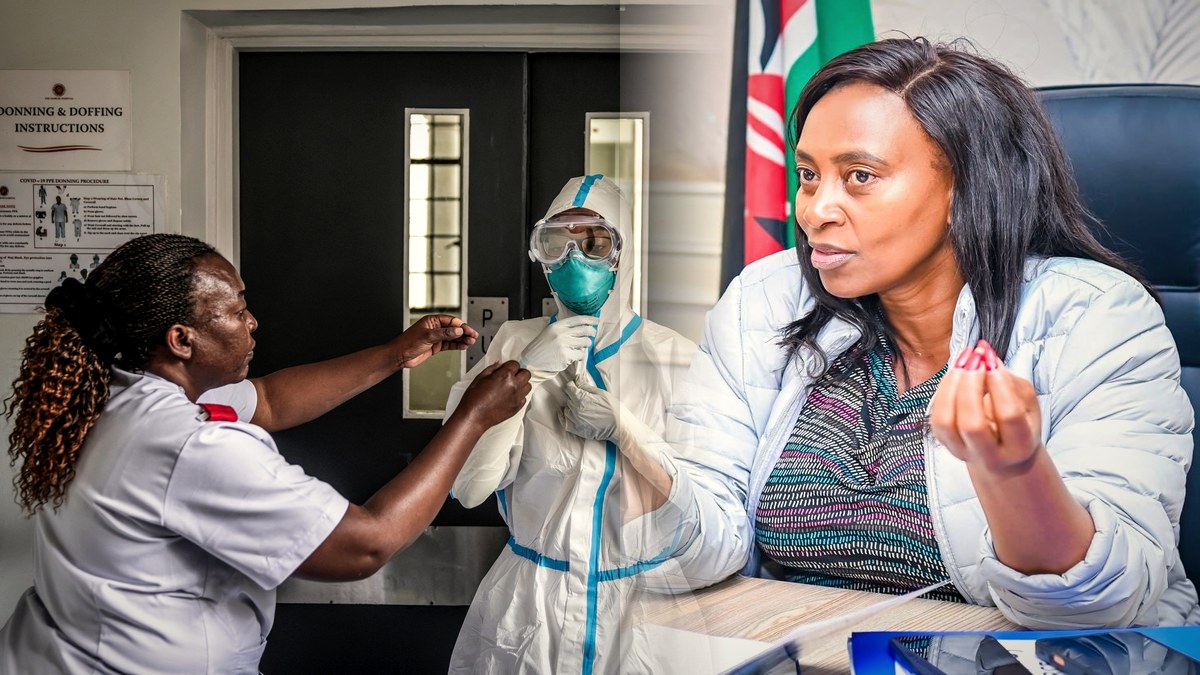
Photos: A nurse helps a colleague put on protective gear at the Ebola isolation unit of The Nairobi Hospital, October 7, 2026 (AFP, via Al Jazeera); Public Health PS Mary Muthoni (KBC).

Tell your story on screen.
Commercials, documentaries, interviews and social video, from script to final cut.





More in Health
See all
Mama Lucy Kibaki Hospital to commission advanced 160-slice CT scanner

First Ebola contacts to leave quarantine on Sunday after 21 days, Amoth says

Public health officers' strike passes 90 days as students warn of nationwide protests

PS Oluga rallies government agencies behind coordinated Ebola response as cases reach nine

Kenya confirms ninth Ebola case as 134 of 135 contacts are traced and quarantined

Tanzania orders 21-day health monitoring for high-risk travellers as Kenya's Ebola cases rise to seven
Global Community Remarks
0