
Making money online from Kenya: a no-nonsense freelancing guide for graduates, from first portfolio to KRA returns
Every WhatsApp group of fresh graduates has that one friend who "makes dollars online". Some genuinely do, through steady freelance clients built over months. Others rent someone else's account, chase "task" apps that demand a deposit, or pay a stranger to "activate" a writing profile, and end up worse off. Online work from Kenya is real, but it is a business, not a lottery. Here is how to approach it properly.
Realistic options for a new graduate
Pick work that matches a skill you can already prove, then grow from there:
- Writing and editing: blog articles, website copy, proofreading, product descriptions. Avoid "academic writing" that means doing other people's coursework; it breaches platform rules and the ethics of the institutions involved.
- Design: logos, social media graphics, presentations, simple video editing.
- Virtual assistance: email and calendar management, customer support, data entry, research.
- Tech: web development, WordPress maintenance, app testing, data analysis, IT support.
- Transcription and translation: Kiswahili and other Kenyan languages can be an advantage.
- Digital marketing: managing social media pages and adverts for small businesses, including Kenyan ones who pay by M-Pesa.
Do not ignore local clients. A Nairobi bakery or a Kisumu hardware shop that needs a website or social media manager is easier to meet, verify and get paid by than an anonymous overseas client.
Get free training first
The government's Ajira Digital programme, led by the Ministry responsible for ICT, has offered free training and mentorship in online work, with Ajira centres and Ajira Clubs at TVET institutions and universities. The government is also rolling out Jitume digital hubs and ward ICT hubs that give young people computers, internet and training. Ask at your county or constituency office, or your former campus, which centre is active near you. These programmes do not charge registration fees; anyone asking you to pay to join "Ajira" is not acting for the programme.
Build a portfolio before you pitch
Clients buy evidence, not certificates.
- Create three to five samples in your chosen service. Redesign a real (public) brand's poster, write three sample blog posts, or build a simple website for a friend's business.
- Put them in one place: a free portfolio site, a shared folder, a GitHub profile for developers or a Behance-style page for designers.
- Write a short profile that says who you help and what result you deliver, not "I am a hardworking graduate".
- Open your own accounts on legitimate freelance platforms in your real name, with your own ID and phone number. Expect weeks of applying before the first job; small first jobs build reviews.
Getting paid
- M-Pesa: the easiest for local clients. Keep a separate line or till for business so your records are clean.
- PayPal: widely used by overseas clients. A verified Kenyan PayPal account can be linked through the Global Payments section of the M-PESA app to withdraw. Check current fees and exchange rates before quoting.
- Bank transfers and payment services: many freelance platforms pay out to a Kenyan bank account, directly or through payment providers. Use an account in your own name.
- Agree payment terms in writing, use the platform's payment system until you trust a client, and never start large jobs without a deposit.
Online income is taxable
Earning in dollars does not put you outside KRA's reach.
- Freelance and online income must be declared on your annual iTax return, due by 30 June.
- If a Kenyan client pays you professional fees or for digital content monetisation, KRA's rate for withholding tax on residents is 5 per cent. This is not a final tax: you declare the full income, claim the withholding certificate as a credit, and pay any balance.
- Turnover Tax does not apply to professional or management fees, so most freelancers file under the normal income tax rules, where expenses such as internet, equipment and platform fees can be claimed if you keep records.
- Keep a simple spreadsheet of every payment received and every business expense. It makes filing, and any bank loan application, much easier.
Avoid account rental and online work scams
- Account rental: "renting" or buying someone else's verified freelance account breaks platform rules. Accounts get suspended, earnings get frozen, and you have no legal claim to money paid into another person's name. It also exposes your ID to strangers.
- Pay-to-work schemes: any "job" that asks for a registration, activation or training fee before you earn is a red flag.
- Task and investment apps: apps that pay you to like videos or rate products, then ask you to deposit money to "unlock" higher earnings, are classic scams.
- Fake clients: overpayments followed by "refund the difference" requests, cheques, or requests for your M-Pesa PIN or one-time codes. No genuine client needs your PIN.
- If you are defrauded, report to the Directorate of Criminal Investigations (dci.go.ke) and to the platform, and keep screenshots of every conversation.
Quick checklist
- One service you can prove, with three to five portfolio samples
- Free training through Ajira Digital or a Jitume or ward ICT hub
- Freelance accounts in your own name only
- Payment method in your name; deposits for big jobs
- Records of income and expenses; annual return by 30 June
- Never pay to get work, and never share your M-Pesa PIN
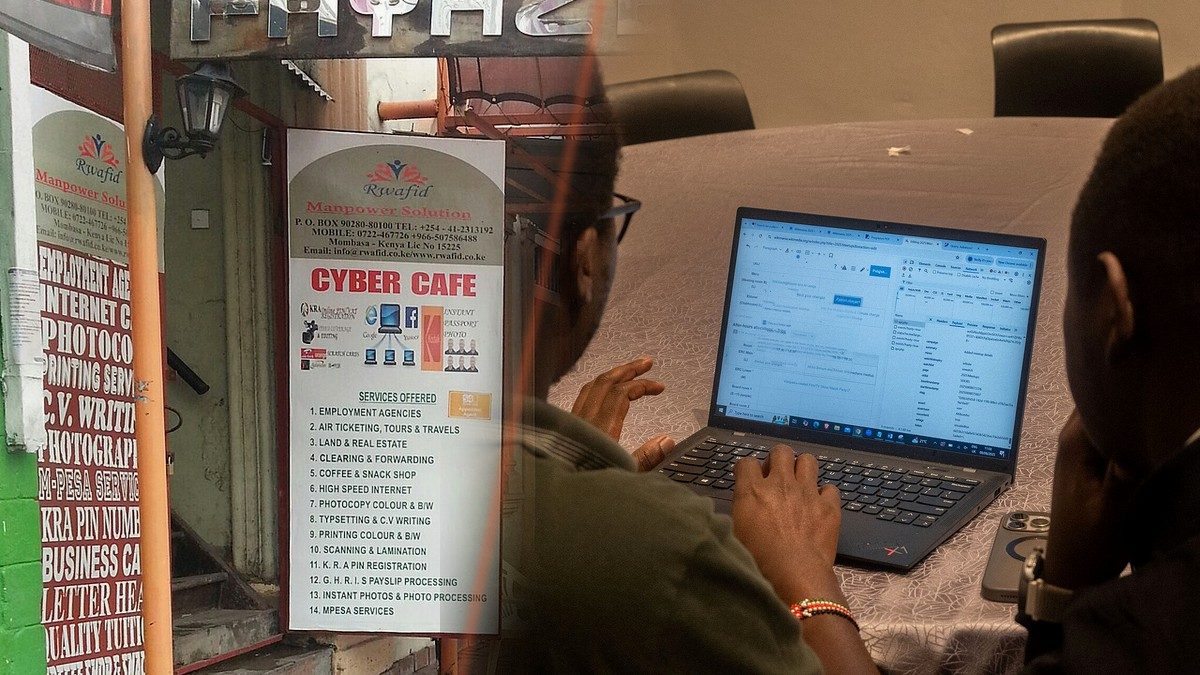
Photos: Cyber cafe in Mombasa by Chaostar (CC BY-SA 3.0); Wikimania Nairobi hackathon by JMcRae-WMF (CC BY-SA 4.0), via Wikimedia Commons. Thumbnail design: HAMASTA MEDIA.


Grow an audience that listens.
Social media management, digital campaigns and online storytelling that converts.



More in Business
See all
KUSCCO Mutual Assurance Statutory Management Extended to December 31

Equity Group nine-month profit rises 32pc to Sh71.5bn on income growth

Treasury Proposes Car Loan and Mortgage Fund for TSC Secretariat Staff

Nigerian fintech Payaza enters Kenya after securing CBK payment licence

Family Bank nine-month profit jumps 69pc to Sh6.07bn on stronger lending
Global Community Remarks
0