
Voyager 1 becomes first human-made object to sit a full light-day from Earth
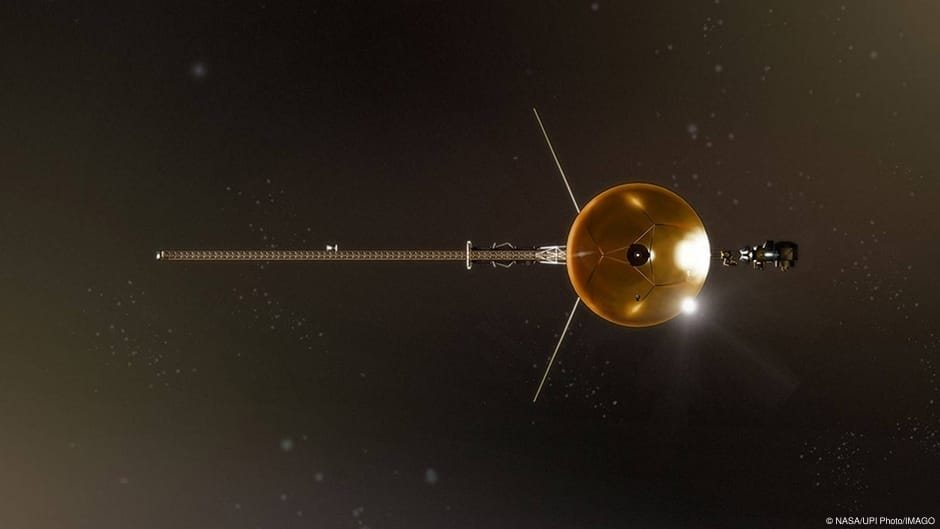
NASA's Voyager 1 spacecraft has become the first object built by humans to travel one light-day from Earth, according to DW News. That is the distance light covers in 24 hours, about 26 billion kilometres.
DW News reported that the probe was due to cross the mark on 18 November 2026 at 11:16 a.m. Central European Time. Voyager 1 launched in 1977, so the journey has taken 49 years, two months and 11 days. Light covers the same distance in a single day.
At that range, any exchange with the spacecraft takes about two days. A signal sent from Earth needs a full day to reach the probe, and its reply needs another day to return.
A two-day wait for a reply
Suzanne Dodd, Voyager's project manager at NASA's Jet Propulsion Laboratory (JPL), told DW News that anyone contacting the craft must send the message and then wait two days for an answer.
The probe is still answering. It continues to return scientific data from a part of space no other spacecraft has explored. Kareem Badaruddin, the mission manager at JPL, said the craft is "still working great".
Voyager 1 is moving at about 61,000 kilometres per hour, according to DW News.
A rare planetary line-up
The spacecraft was launched to take advantage of an unusual alignment of Jupiter, Saturn, Uranus and Neptune. That arrangement happens only once every 176 years, and scientists wanted to use it to study the outer planets.
After its main mission, Voyager 1 used Jupiter and Saturn for gravitational slingshots. In each case it passed close to a planet, was pulled in by its strong gravity and swung away faster than before. These manoeuvres gave the probe its high speed.
Milestones along the way
The mission has passed several historic points:
- 14 February 1990: From beyond Neptune, Voyager 1 took the only picture of the solar system ever captured by a spacecraft from outside it.
- 2012: It became the first human-made object to enter interstellar space.
- 2026: It reached one light-day from Earth.
The journey will go on long after the probe's plutonium power source runs out. DW News reported that Voyager 1 will need about 18,000 years to reach one light-year from Earth. In about 40,000 years it will pass the star Gliese 445, which lies more than 17 light-years away. NASA expects the craft to keep drifting through the Milky Way, possibly forever.
The Golden Record
Voyager 1 also carries objects meant as messages from Earth to any extraterrestrial beings who might find it. The best known is the Golden Record, a phonograph disc with sound clips that represent languages and cultures from around the world.
Scientists consider it very unlikely that intelligent life will ever find the record or work out how to play it. If anyone does, the first voice they hear will be a controversial one, DW News noted.
The opening words come from Kurt Waldheim. He served as United Nations Secretary-General from 1972 to 1981 and later as President of Austria from 1986 to 1992. About a decade after Voyager 1 launched, it emerged that he had hidden his wartime service as a German army officer in the Balkans, and he was accused of taking part in Nazi crimes. His voice therefore sits uneasily with the record's original aim of presenting a united Earth.
This story was prepared by the Hamasta Newsdesk with AI assistance, based on reporting by DW News. Read the original report. Photo: DW News.



Know what people say about you.
Media monitoring, audience insights and strategic communication for your brand.


More in Technology
See all
Kenya's Data Commissioner Immaculate Kassait Wins Global Buttarelli Privacy Award

Kenya retains ITU Council seat with highest vote tally among African nations

'That mountain has been causing you problems': Ruto promises four lanes for the jam-choked Rironi-Mai Mahiu escarpment road

Sh700 billion moved in a year, and now every exchange needs a licence: What Kenya's new crypto rules mean for your wallet

'Huyu ni mwizi': Stabbed and robbed of his phone, Nairobi techie builds a remote that makes a snatched handset scream at the thief

Global Community Remarks
0