
Kenya and EU conclude talks on landmark data protection adequacy deal
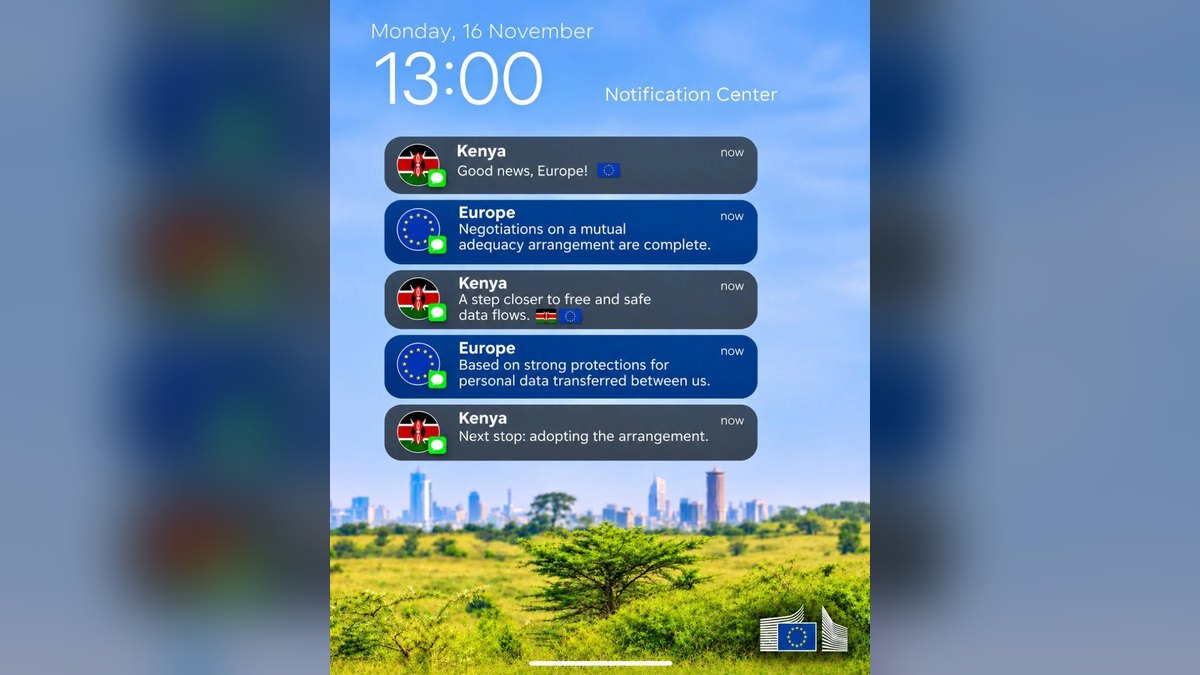
Kenya and the European Union have concluded negotiations on a mutual data protection adequacy arrangement, a move expected to open new investment opportunities in the country's digital services and Business Process Outsourcing (BPO) sectors, according to Capital FM Kenya.
If formally adopted, the arrangement would make Kenya the first African country to establish a mutual data adequacy arrangement with the EU.
The conclusion of the talks was welcomed by European Commissioner for Democracy, Justice, the Rule of Law and Consumer Protection Michael McGrath and Kenya's Data Commissioner Immaculate Kassait. The two officials met to review progress towards the deal.
What the arrangement means
The proposed arrangement is designed to allow personal data to move securely between Kenya and the EU. This is expected to make it easier for businesses that operate across both markets to share information without additional barriers.
According to Capital FM Kenya, the deal is also expected to:
- Improve access to data for research purposes
- Support the growth of Kenya's digital services exports
- Strengthen the business environment and create more opportunities for trade and investment
The arrangement is expected to complement the existing EU-Kenya Economic Partnership Agreement, which governs trade relations between the two sides.
Two years of negotiations
Talks on the arrangement began in 2024. They were conducted between the European Commission's Directorate-General for Democracy, Justice, the Rule of Law and Consumer Protection and Kenya's Office of the Data Protection Commissioner (ODPC).
Both sides acknowledged what was described as growing alignment between their respective data protection frameworks. That alignment paves the way for each jurisdiction to adopt formal adequacy decisions, the final step needed for the arrangement to take effect.
Why adequacy matters
An adequacy finding is a formal recognition that another jurisdiction offers a level of protection for personal data comparable to one's own. A mutual arrangement means both the EU and Kenya would recognise each other's systems, allowing data to flow in both directions with fewer legal hurdles.
For Kenya, the deal could be significant for companies in the BPO and digital services space, many of which handle customer data on behalf of clients abroad. Easier and more secure data transfers with the EU could make Kenyan firms more attractive partners for European businesses.
Kenya's Office of the Data Protection Commissioner, led by Kassait, oversees the enforcement of the country's data protection law, which was enacted in 2019.
Next steps
While negotiations have been concluded, the arrangement is not yet in force. Both Kenya and the EU must still adopt formal adequacy decisions before data can begin moving under the new framework.
No timeline for the adoption of those decisions was given in the report by Capital FM Kenya.
Once finalised, the agreement would position Kenya as a regional pioneer in aligning its data governance with one of the world's most stringent data protection regimes.
This story was prepared by the Hamasta Newsdesk with AI assistance, based on reporting by Capital FM Kenya. Read the original report.
Photo: European Commission, via Capital FM.


Grow an audience that listens.
Social media management, digital campaigns and online storytelling that converts.



More in Technology
See all
AI helps uncover critical decade-old security flaw in Java programming language

Waymo halts driverless taxi rides on all US freeways after California ban
Europe bets €400m on light-based photonic chips to win next tech race

Kenya's Data Commissioner Immaculate Kassait Wins Global Buttarelli Privacy Award

Voyager 1 becomes first human-made object to sit a full light-day from Earth
Global Community Remarks
0