
Chivayo helicopter crash: Report says aircraft flew into fog, no mechanical fault found
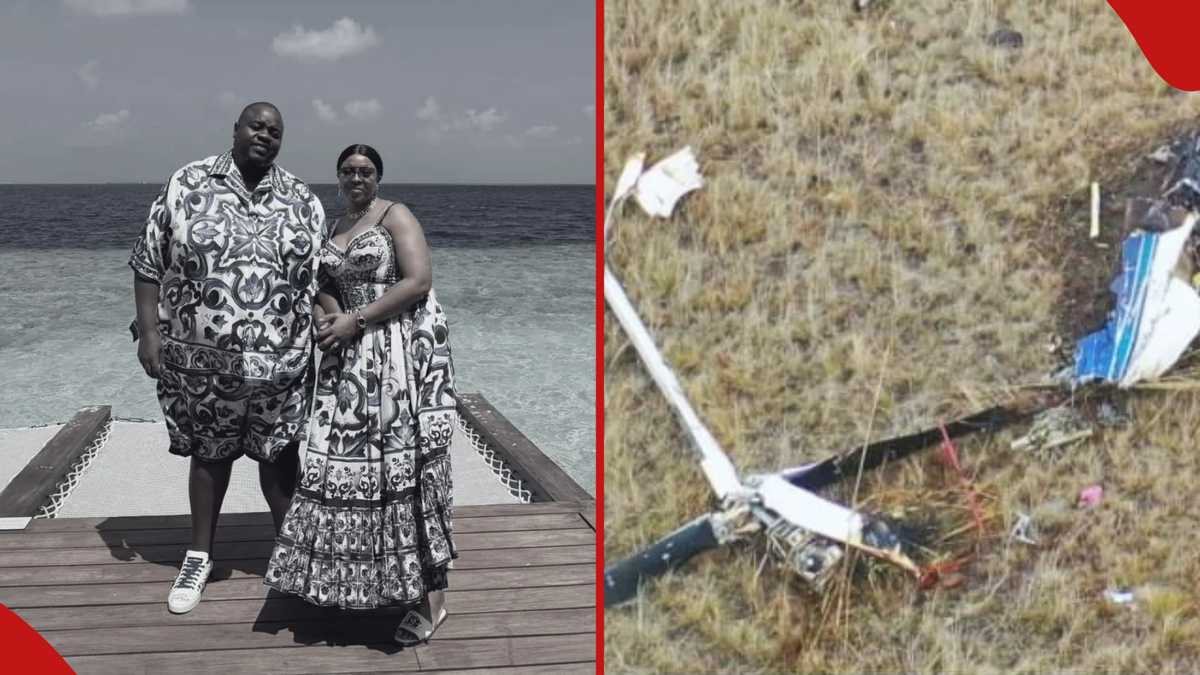
The helicopter that killed Zimbabwean businessman Wicknell Chivayo, his wife and three other people flew into fog and low cloud before striking the ground, and investigators have found no sign of mechanical failure, according to a preliminary report cited by Tuko.
The report, released by Zimbabwe's Air Accidents and Incidents Investigation Department, sets out the sequence of events before the Bell 430, registration Z-PED, went down at Kudenga Farm in Mashonaland East on September 30, 2026. The crash site lies about 22 km southwest of Marondera.
All five people on board, the pilot and four passengers, died at the scene.
Two helicopters, two different routes
According to the report, Chivayo's helicopter left Gandami Village at 1420 UTC alongside a second aircraft, a Bell 407 registered Z-OSM. The two were flying together under visual flight rules, heading towards Marondera.
About ten minutes after take-off, a band of low cloud was reported moving in from the east. The crew of the Bell 407 changed course to the west to avoid it and reached their destination without incident.
Investigators say the pilot of Z-PED, however, kept flying north-east, reporting that the way ahead looked clear. A later radio message indicated the helicopter had flown into another layer of cloud and had not yet emerged from it.
Witnesses heard circling, then impact
People at Kudenga Farm told investigators they heard a helicopter circling overhead at around 2.50pm local time. Drizzle and thick fog meant they could not see it.
The circling went on for roughly ten minutes before witnesses heard a loud crash, followed by silence.
Police in Marondera were alerted at about 3pm and reached the site some 15 minutes later. They found the wreckage on fire in a field and no survivors.
No break-up in the air
Debris was spread over an area about 170 metres long. Investigators said the pattern showed the helicopter was still in one piece until it hit the ground, with no evidence of an explosion or break-up in flight.
The aircraft was destroyed by the impact and a fire fuelled by its own fuel. The report describes the crash as not survivable, noting that the occupants were thrown from the fuselage as it broke apart on first impact.
The accident has been classified as unintended flight into instrument meteorological conditions and controlled flight into terrain. In plain terms, the aircraft was still being flown under control when it struck the ground after entering weather that required flying by instruments.
Pilot and aircraft records
The 44-year-old commercial pilot had logged 2,756 flying hours, 614 of them on the Bell 430, the report states. His medical certificate was valid and investigators found nothing to suggest he had been incapacitated.
The helicopter was built in 2004 and last inspected on August 25, 2026. Its certificate of airworthiness was valid until May 2027, and investigators identified no shortcomings in how the operator, Sky Helicopters, maintained it.
The Meteorological Services Department had issued a severe weather advisory covering the period, warning of thunderstorms, strong gusts and heavy rain.
Final report pending
The cockpit voice recorder was not found and is believed to have been destroyed.
Investigators stressed that the preliminary document only provides an initial outline of the facts and does not determine a probable cause. A final report, including full maintenance records and analysis, will follow, though no date has been set.
Separately, Tuko reported on fresh claims that Chivayo's Gulfstream G550 private jet belonged to a Swiss company and had been returned to Switzerland. The allegations contradict Chivayo's earlier statement that he bought the jet for about US$34 million.
This story was prepared by the Hamasta Newsdesk with AI assistance, based on reporting by Tuko. Read the original report. Photo: Tuko.


Take your event live to thousands.
Multi-camera live streams, panel discussions and digital broadcasts with professional crews.




More in International
See all
Canada and China agree new tariff cuts as both look to reduce reliance on US

Mongolia's President Khurelsukh to resign over railway corruption claims
Botswana's Boko and Ivory Coast's Ouattara sign mining, energy and trade deals
Ukraine says Russia is targeting rescuers after 'double-tap' strike killed 72
Muhoozi back on X, warns media of 10-year jail terms over criticism of Museveni

Global Community Remarks
0