
Hegseth signs military cooperation deal with Venezuela on Caracas visit
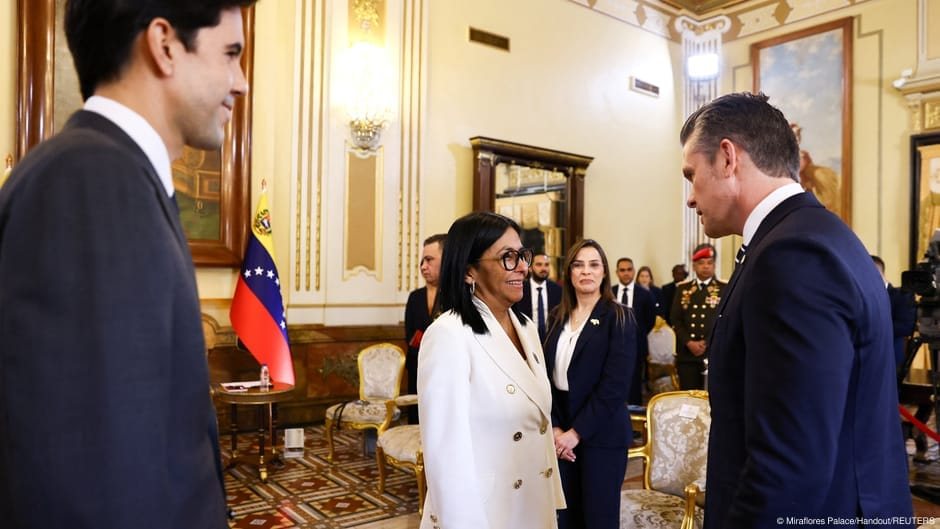
US Defence Secretary Pete Hegseth has signed a military cooperation agreement with Venezuela during a visit to Caracas, marking a sharp turn in relations between Washington and a country it long regarded as a regional adversary, according to DW News.
Hegseth met Venezuela's interim authorities on Wednesday. The trip was shown on Venezuelan state media, but the Pentagon neither released details about it nor confirmed it had taken place, DW News reported.
Training, technology and intelligence
Hegseth and acting President Delcy Rodriguez promoted the agreement at the presidential palace in the Venezuelan capital. Rodriguez said the pact would improve training for Venezuela's armed forces and give them access to new technologies, enabling the two countries to confront what she called shared threats.
Under the deal, the two nations will carry out joint training and exchange intelligence.
Hegseth described the agreement as a restoration of defence ties between the two militaries. He said Washington wanted to make sure Venezuelans were protected from foreign actors, criminals and what he termed narco-terrorists, and could live safely within their own borders.
He also framed the change in starker terms. Since Maduro's removal, Hegseth said, Venezuela
"has gone from our most aggressive regional threat to a compliant security partner."
From hostility to partnership
The visit follows the January operation in which US forces removed former President Nicolas Maduro from power and flew him and his wife to New York, where he faces drug trafficking charges. President Donald Trump has since supported Rodriguez, who served as Maduro's vice president, as the country's leader.
Relations between the two countries were strained throughout Maduro's time in office, which began in 2013. In 2019, Maduro severed formal diplomatic ties with Washington after Trump's first administration recognised opposition figure Juan Guaido as Venezuela's interim president.
After Maduro's ouster, the Trump administration pressed Caracas to meet a series of demands, including opening Venezuela's oil market to the United States. Trump at one point warned Rodriguez she could suffer a fate worse than Maduro's if she failed to cooperate, before later praising her as a "terrific person" doing a "great job", DW News reported.
Oil, prisoners and the question of elections
Since taking charge, Rodriguez's government has freed political prisoners and eased oil shipments to the United States. Under an energy arrangement, Washington controls the proceeds from those sales and then returns the money to Venezuela.
US Secretary of State Marco Rubio has been overseeing the transition and remains in close contact with Rodriguez, according to DW News.
Elections are expected at some point, but with the interim government cooperating closely with Washington, it is not clear when a vote might take place. Opposition leader and Nobel Prize laureate Maria Corina Machado has recently called for elections after returning to Venezuela.
Venezuela holds some of the world's largest proven oil reserves, which has kept its political direction under close international scrutiny, including among oil-importing economies in Africa and elsewhere.
This story was prepared by the Hamasta Newsdesk with AI assistance, based on reporting by DW News. Read the original report. Photo: DW News.



Know what people say about you.
Media monitoring, audience insights and strategic communication for your brand.


More in International
See all.jpeg)
EU gives Sh78 million to aid Ethiopians displaced into Moyale by clashes
Iraq jails six French nationals for life over ISIL membership
US lawmakers push for $25 federal minimum wage and end to tipped pay system
'Ghana Must Go' bag: from symbol of 1983 expulsion to global everyday staple
US Democrats probe Lutnick over Megaspeed decision amid Nvidia scandal
Global Community Remarks
0