
Zelenskyy presses NATO for membership and air defence, but allies remain divided
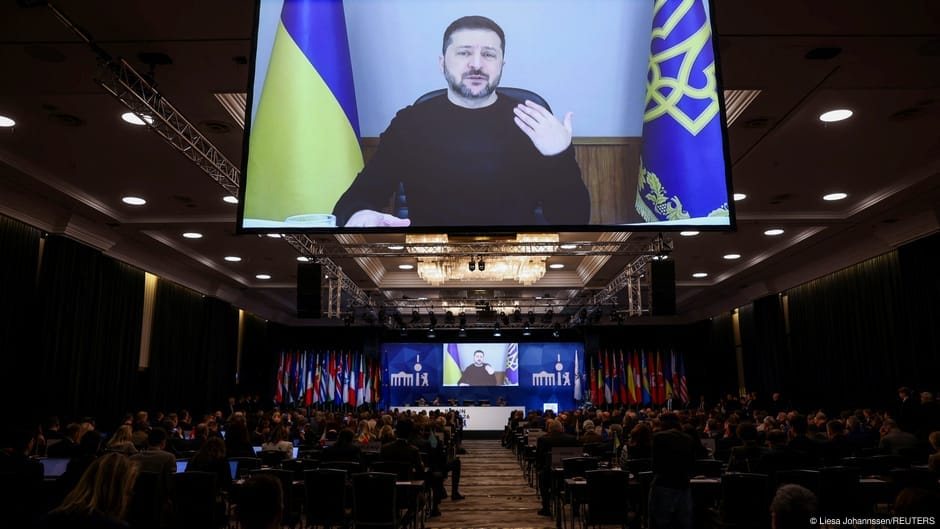
Ukrainian President Volodymyr Zelenskyy has renewed his appeal for Ukraine to be admitted swiftly into NATO and for allies to supply more air defence systems, but the alliance remains split on whether Kyiv should join, according to DW News.
Zelenskyy addressed lawmakers from NATO's 32 member states by video link at the 72nd annual meeting of the NATO Parliamentary Assembly, held in Berlin. Delegates applauded when the connection, which took some time to establish, finally went through.
Air defence the top priority
With winter approaching, the Ukrainian leader said protecting his country from heavy Russian aerial bombardment was his most pressing concern. He asked allied nations to release Patriot batteries and other advanced anti-air systems from their stocks.
Zelenskyy argued that missiles capable of intercepting Russian ballistic missiles should not be left idle in storage, and openly asked parliamentarians for help in getting them to Ukraine.
Membership call meets resistance
Although the assembly has no power to decide on new members, Zelenskyy used the platform to repeat his request for membership. He said Ukraine would need firm security guarantees once the war ends, and suggested that bringing the country into the alliance would be cheaper, simpler and more dependable than other arrangements.
NATO has repeatedly stated that Ukraine's path to membership remains open, but it has framed this as a long-term prospect. The ongoing war and the mutual defence obligations that membership would place on other allies are the main reasons for caution, DW News reported.
NATO Secretary General Mark Rutte turned down the Ukrainian demands at the gathering, the first held in Berlin in 26 years. He said Ukraine had prospects of joining but that members were not currently unanimous, and stressed that only NATO decides who becomes a member.
Rutte said whether membership could feature in any negotiations with Russia was a separate question. He welcomed current US efforts to broker peace talks and noted that Europe was consulting closely with Ukraine and Washington to forge a common position, adding that it remained to be seen whether Russian President Vladimir Putin was willing to engage.
Merz looks back to 2008
German Chancellor Friedrich Merz said Ukraine should receive security guarantees comparable to those enjoyed by NATO members in the event of a ceasefire. Speaking at a joint press conference with Rutte, he described the alliance's failure to act on an American proposal at the 2008 Bucharest summit to admit Ukraine as a mistake in hindsight.
Spending targets and weapons production
Russia's invasion has prompted a major rearmament drive across the alliance, with members committing to raise defence spending to 5% of gross domestic product by 2035. Rutte said every ally needed a credible route to that target and ideally should reach it earlier. He also warned that demand for weapons still far outstrips supply, calling for higher production among member states.
Germany's top soldier, General Carsten Breuer, told delegates that the country's defence budget has tripled since 2021 and will exceed €139 billion ($151 billion) next year. He said Germany aims to hit the 5% target, agreed at the summit in The Hague, well before the 2035 deadline.
Breuer said the Bundeswehr plans to grow to 460,000 personnel by the mid-2030s, including 200,000 reservists, describing the task of balancing expansion with operational readiness as "like walking a tightrope".
Breuer has been elected chair of the NATO Military Committee and will move to the alliance's Brussels headquarters in the middle of next year, becoming the principal military adviser to Rutte. He said he saw his election as recognition that Germany had embraced its responsibility in security policy.
This story was prepared by the Hamasta Newsdesk with AI assistance, based on reporting by DW News. Read the original report. Photo: DW News.

Tell your story on screen.
Commercials, documentaries, interviews and social video, from script to final cut.





More in International
See all
Macron calls on Ukraine's allies to reopen debate on Kyiv joining NATO
US sounds out Ukraine on ceding Donetsk for NATO-style security guarantees
Zelenskyy presses US over Patriot missiles as Russian strikes kill seven
Zelensky calls for urgent four-way peace talks with Russia, Europe and US
Hungary's Magyar meets Zelenskyy in Ukraine as Budapest-Kyiv ties thaw
Global Community Remarks
0