
China launches Shenzhou-24 crew with first foreign astronaut, a Pakistani pilot
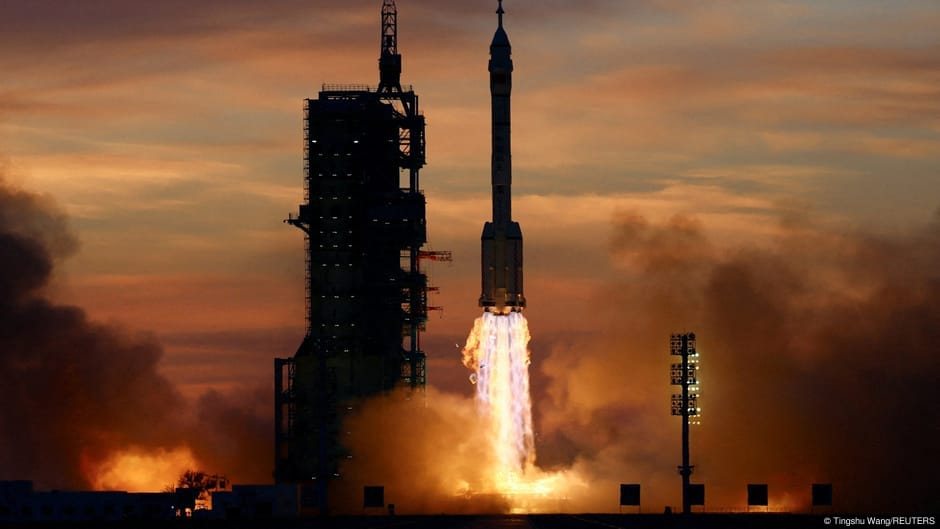
China has sent a new three-member crew to its Tiangong space station, including a Pakistani pilot who becomes the first foreign national to fly on a Chinese crewed mission, according to DW News.
The Shenzhou-24 spacecraft lifted off aboard a Long March-2F rocket at 8:18am local time (0018 GMT) from the Jiuquan launch centre in the Gobi Desert. The China Manned Space Agency said the capsule separated from the rocket roughly 10 minutes after launch and reached orbit, describing the mission as a "complete success".
Footage aired by state broadcaster CCTV showed the three crew members paging through a manual minutes after liftoff. The broadcaster reported that all three were in good condition.
A veteran, a newcomer and a Pakistani first
The mission is led by Tang Hongbo, who is making his third journey into space. According to CCTV, he will become the first astronaut to board Tiangong three times.
Flying alongside him are two first-timers: Wu Yi and Pakistani pilot Muhammad Zeeshan Ali. Ali's visit to the station will be brief.
Speaking at a news conference on Tuesday, Ali moved between Urdu, Mandarin and English as he described the significance of the flight for his country.
"I carry the name of Pakistan on my shoulder, the hopes of 250 million Pakistanis," Ali said.
Tang told the same briefing that differences in language, culture and psychology had made working as a team more difficult, but said efforts from both sides were paying off.
An unusual handover in orbit
The crew rotation on the station will not follow the usual pattern. Zhu Yangzhu, commander of the outgoing Shenzhou-23 mission, will stay aboard Tiangong for a full year.
The other two members of his crew, Zhang Zhiyuan and Lai Ka-ying, who is Hong Kong's first astronaut, will return to Earth together with Ali.
Zhu's assignment is reportedly China's first year-long stint in space. Reuters described it as set to become the longest single stay by a Chinese astronaut. The mission has been framed as a test of how the human body copes with extended time in orbit, as China prepares for planned Moon missions and a possible future journey to Mars.
According to the state news agency Xinhua, the crew will carry out more than 90 experiments and technology tests during their time on the station.
Moon ambitions unchanged
China's goal of landing astronauts on the Moon by 2030 remains in place, despite a delay to its Chang'e-7 lunar mission, DW News reported. The United States is targeting 2028 for its own crewed lunar landing, setting up a closely watched race between the two space powers.
The inclusion of a Pakistani crew member marks a notable step for China's crewed space programme, which until now has flown only Chinese astronauts. It also highlights Beijing's growing use of space cooperation as part of its wider international partnerships.
Reflecting on the intensive preparation for the mission, Ali, speaking in Mandarin, likened the experience to his daily training, saying it involved reaching new heights day after day.
This story was prepared by the Hamasta Newsdesk with AI assistance, based on reporting by DW News. Read the original report. Photo: DW News.




Know what people say about you.
Media monitoring, audience insights and strategic communication for your brand.


More in International
See all
Taliban accuse Pakistan of backing armed groups opposed to their rule
Pakistani minister visits New Delhi for SCO forum, first such trip since 2023

Pakistani man jailed 27 years over Iran-linked plot to kill Trump and Biden
Saudi, Pakistani and Turkish envoys rush to Tehran to stop Iran war from reigniting

South African pilot survives DRC plane crash that killed three, held by rebels

Global Community Remarks
0