
Ruto Directs CUE to Review All University Courses Amid Graduate Jobs Concerns
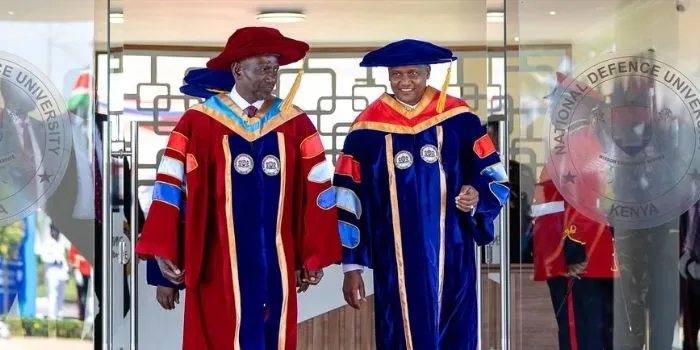
President William Ruto has instructed the Commission for University Education (CUE) to carry out an immediate review of every academic programme offered by Kenyan universities, putting the value of degrees in a shifting job market back under the spotlight.
The President issued the directive on Thursday, November 26, while addressing a graduation ceremony at the National Defence University-Kenya in Lanet, Nakuru County, according to Kenyans.co.ke.
He told the gathering that universities must routinely evaluate the courses they offer to make sure they serve the country's development goals, and called for closer examination of programmes that have already been approved.
Warning on outdated knowledge
Ruto cautioned that rapid economic and technological change could leave university teaching behind unless institutions kept updating their curricula.
"The rate at which the world is changing, knowledge can be obsolete unless it is continuously refined," Ruto said.
He also said accredited institutions needed more support, alongside further assessments to measure the impact their programmes have on society.
A growing sector under pressure
The order comes as Kenya's university system keeps expanding. The CUE's most recent register lists 36 public and 33 private chartered universities.
That growth has prompted debate over whether graduates are leaving with the skills employers want, especially as artificial intelligence and other new technologies change the nature of work.
A CUE study on graduate employability, cited by Kenyans.co.ke, found that it takes Kenyan graduates an average of 11.6 months to land their first job. Only 25.3 per cent found work within six months of finishing their studies.
The study identified several key obstacles facing job seekers:
- Lack of work experience
- Limited job opportunities
- A mismatch between graduates' skills and employers' needs
Link to CBET transition
The concerns tie in with the government's plan to shift universities to Competency-Based Education and Training (CBET), an approach that prioritises practical skills, demonstrated competencies and the ability to apply learning in real workplaces.
In September, the Ministry of Education sought consultants to gauge how far public and private universities had gone in adopting CBET and whether their programmes fit the new model.
One planned assessment was to check whether courses have suitable learning outcomes, practical training elements and industry-relevant skills, and to recommend changes needed to bring existing programmes into line with CBET.
A second assessment was meant to measure universities' progress in rolling out the system, including how prepared lecturers are and whether institutions have the infrastructure to support the change.
What the review is expected to cover
Under the President's directive, the CUE is expected to examine whether approved courses are keeping up with technological developments, employer expectations and Kenya's development priorities, among other areas.
The commission has not yet publicly outlined a timeline or the process it will use for the review.
This story was prepared by the Hamasta Newsdesk with AI assistance, based on reporting by Kenyans.co.ke. Read the original report. Photo: Kenyans.co.ke.
Every moment, captured beautifully.
Events, corporate portraits, products and editorial shoots by our newsroom photographers.






More in Education
See all
KMTC to review its 126 courses after MPs warn graduates are struggling to find jobs

High Court Quashes Education Ministry Directive Merging Teacher Diploma Courses

Ruto directs BOM-employed teachers be moved to government payroll
.jpeg)
Court orders Egerton to issue certificates to 224 engineering graduates within 30 days

Flagship Biography: William Samoei Arap Ruto
Global Community Remarks
0