
Dutch customs seize 26 critically endangered turtles from Hong Kong-bound traveller
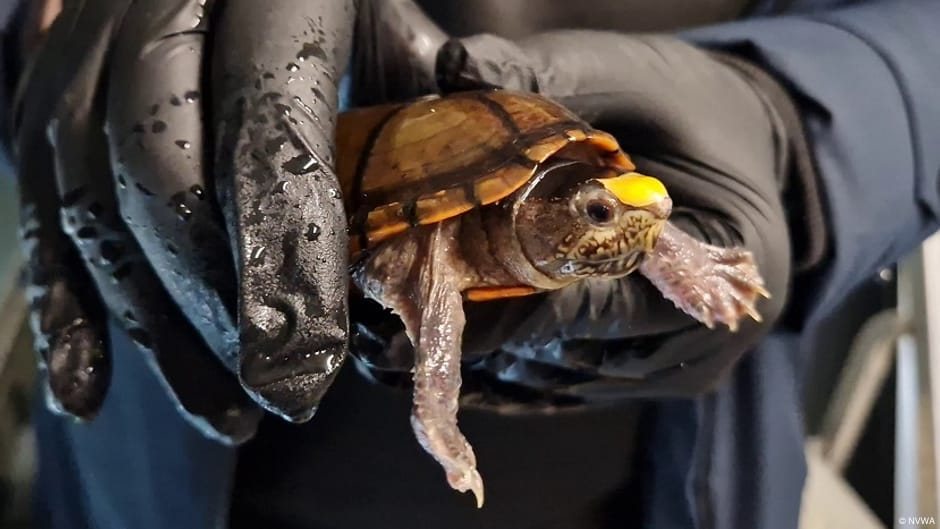
Dutch authorities have seized 26 critically endangered turtles from the luggage of a man travelling to Hong Kong through Amsterdam's Schiphol Airport, in a haul that may represent close to a tenth of the species' entire wild population, according to DW News.
The Netherlands Food and Consumer Product Safety Authority (NVWA) announced the seizure on Friday. The animals were Vallarta mud turtles, a tiny freshwater species found only in western Mexico and formally catalogued by scientists as recently as 2018.
The NVWA said the turtles were most likely taken from the wild in Mexico, where only about 300 are believed to survive.
Wrapped in duct tape
Customs officers came across the animals on November 21 during a routine inspection. On realising the shipment contained live animals, they called in the NVWA, the agency responsible for such cases.
According to the authority, most of the turtles had been packed into a box together with a toy car, while the rest were hidden inside a sealed sock in a suitcase. Each animal had been bound in duct tape, leaving it unable to move.
Despite the conditions, all 26 turtles survived. They have since been moved to a specialised rescue centre, where the tape was carefully removed and they are receiving care, the NVWA said.
Police arrested the traveller at the agency's request. The NVWA said he remained in custody as prosecutors continue their investigation.
A species on the brink
The Vallarta mud turtle is among the smallest turtle species known, growing to no more than about 10 centimetres in length. Because it was identified so recently, scientists still know relatively little about it.
Its habitat in the Mexican state of Jalisco has been heavily damaged by urban expansion and a growing tourism industry. Turtle Island, a conservation organisation based in Graz, Austria, which describes the animal as the world's smallest turtle species, estimates that more than 99 per cent of its natural habitat has been lost to urbanisation. Roads and traffic pose a particular danger to the slow-moving reptiles.
The group, which has begun breeding the turtles in Austria as a genetic reserve for possible future reintroduction and supports conservation work in Mexico, also warns that collectors are a serious threat.
"Their small size and striking appearance make them prime targets for illegal collectors," Turtle Island says.
The species is listed as Critically Endangered on the IUCN Red List and enjoys the highest level of protection under the Convention on International Trade in Endangered Species of Wild Fauna and Flora (CITES).
Significant blow to wild numbers
Based on the estimated wild population of around 300, the NVWA said the suspected poaching of the 26 turtles may have cut the species' numbers by nearly 10 per cent.
The agency has urged members of the public to report any suspected illegal trade in protected animals or plants, including through online forums, marketplaces, bird fairs and antique or curiosity markets.
The case adds to growing concern worldwide about the smuggling of live reptiles, with small, rare species particularly vulnerable because they can be easily concealed in personal luggage.
This story was prepared by the Hamasta Newsdesk with AI assistance, based on reporting by DW News. Read the original report. Photo: DW News.
Every moment, captured beautifully.
Events, corporate portraits, products and editorial shoots by our newsroom photographers.






More in Environment
See all
Two months from freedom, now likely locked up until 2036: Hong Kong's Joshua Wong jailed 10 more years for 'collusion'

Hong Kong fire that killed 168 was preventable, report finds as families await justice
.jpeg)
Russian strikes damage Austrian and Dutch embassies in Kyiv, staff unhurt

Konza Technopolis gets KRA customs code, edging closer to full SEZ operations

KRA seizes 52 phones and three drones at JKIA after airport cleaner tries to flee customs officers
Global Community Remarks
0