
Germany's IG Metall calls 23,000 workers out on new 24-hour strike over pay
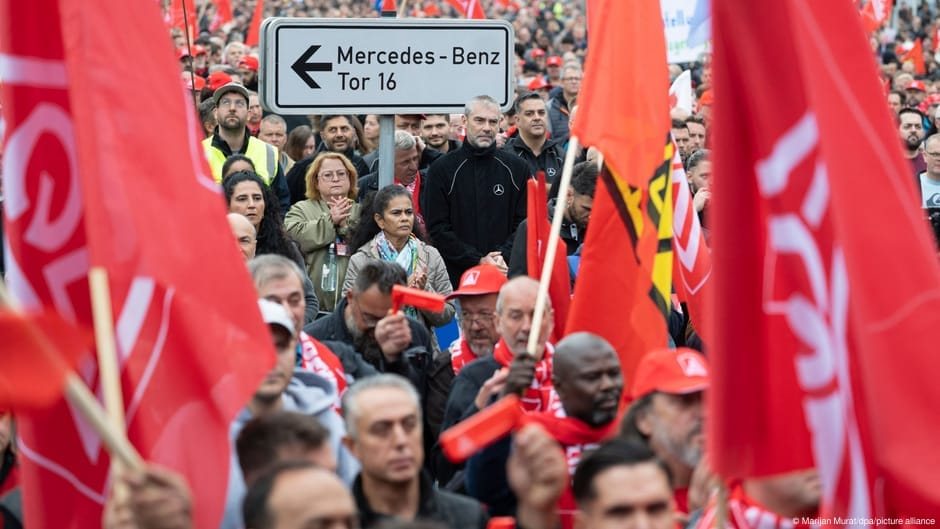
Germany's biggest single trade union, IG Metall, has called a fresh 24-hour strike for Monday, stepping up pressure on employers in a pay dispute affecting car, shipbuilding and wind energy workers, according to DW News.
The union said on Sunday that about 23,000 workers at 19 companies in northern Germany had been asked to take part in the walkout.
Among the firms affected are carmaker Mercedes-Benz, shipbuilder Meyer Werft and wind energy company Siemens Gamesa.
Second walkout in days
Monday's action follows an earlier strike on Friday. According to the union, about 12,300 workers left their posts at 17 facilities during that stoppage.
IG Metall says the strikes are intended to force employers to give ground on its demands, which include a 5% wage increase.
Employers have so far offered a one-off payment next year, followed by a 1.3% pay rise starting in July 2028, DW News reported. The gap between the two positions points to a dispute that could drag on.
Pressure on Europe's largest economy
The industrial action comes at a difficult time for Germany. The government is spending billions of euros to modernise public infrastructure and digital networks and to speed up the shift to renewable energy, in one of the country's largest public investment drives in decades.
But DW News notes that the plan faces obstacles including labour shortages, heavy bureaucracy and low productivity.
Households are also facing higher energy bills. Comparison website Verivox expects about 3.7 million households on standard tariffs to pay roughly 2% more for electricity next year. Some 1.9 million households will see gas prices rise by about 14% over December, January and February, after 361 regional suppliers announced increases.
Verivox energy expert Thorsten Storck linked the increases to wholesale prices, which he said had risen sharply since the Iran war began in March 2026 and were only now reaching consumers.
The coalition government has agreed to cut the electricity tax rate for 2027 to the European minimum level, which has softened some of the impact on households and businesses.
Steinmeier heads to Africa
In other news from Germany, President Frank-Walter Steinmeier is setting off on a trip to Africa, where he is due to visit three countries accompanied by a business delegation, DW News reported. The broadcaster did not name the countries in its report.
Separately, there was some relief for German shippers. The Rhine River has recovered after a long dry spell, allowing barges on the key waterway to carry full loads again.
Divided views on Ukraine aid
A YouGov survey carried out for the newspaper Welt am Sonntag between November 13 and 16 found that 49% of people in Germany want Berlin's aid to Ukraine either cut back or stopped altogether.
Of those, 25% favoured ending aid and 24% wanted it reduced. Some 30% backed keeping support at its current level, 9% wanted it increased and 11% were undecided.
The poll came in the same week that Chancellor Friedrich Merz hosted a meeting of Ukraine's European allies, known as the Coalition of the Willing, aimed at keeping a united front as peace talks continue.
This story was prepared by the Hamasta Newsdesk with AI assistance, based on reporting by DW News. Read the original report. Photo: DW News.

Tell your story on screen.
Commercials, documentaries, interviews and social video, from script to final cut.





More in International
See all
Washington governor condemns ICE arrests of two people on Seattle airport jet bridge
Somalia expels UAE envoy as row with Abu Dhabi tangles with domestic power fight
Three dead, 36 missing after fire guts Indonesian candy factory in Banten
COP31 talks in overtime as new draft deal seeks to rescue climate summit

Darfur families displaced to Khartoum brace for cold winter as Sudan aid dries up
Global Community Remarks
0