
Euclid telescope spots oldest quasar yet, seen 630 million years after Big Bang
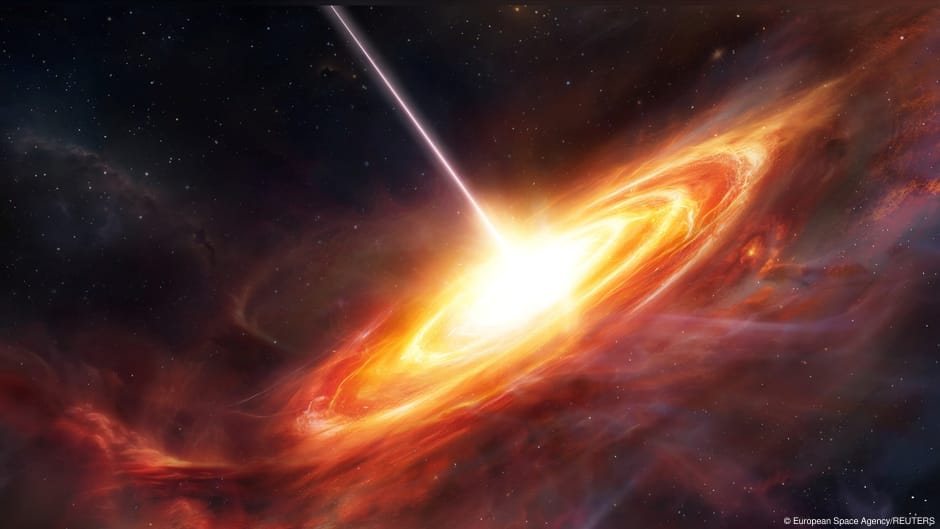
Astronomers have identified the most distant quasar ever observed, an object whose light shows it as it was about 13.1 billion years ago, only 630 million years after the Big Bang, according to DW News.
Researchers at the European Space Agency (ESA) announced the find on Tuesday. The universe was then less than 5% of its present age. Because the quasar is so far away, it is also the oldest of its kind yet recorded.
The work was carried out by a German astronomer and his team. Their findings appear in the journal Astronomy and Astrophysics.
A giant black hole, early on
The object is formally catalogued as J1504+6252. It has been nicknamed Dún Aonghas.
Lead author Julien Wolf, an astronomer at the European Southern Observatory in Germany, said the discovery strengthens the case that some objects in the young universe matured surprisingly fast.
According to Wolf, the black hole at the centre of the quasar had already reached a mass roughly 360 million times that of the sun when the universe was only 630 million years old. It was already shining brightly as a quasar at that point.
"I think it adds to the evidence that some objects in the early universe developed remarkably quickly," Wolf said.
The researchers say the result supports one explanation of how supermassive black holes come about. In that scenario, large clouds of gas collapse directly into a black hole, which then grows by drawing in more material.
What is a quasar?
A quasar is the intensely bright core of an active galaxy. Its energy comes from gas falling into a supermassive black hole at the galaxy's heart.
Quasars mark a short stage in the life of a galaxy. During this phase the central region can outshine everything else in the system.
Study co-author Silvia Belladitta explained the process. She works at the Max Planck Institute for Astronomy in Germany and at the INAF Bologna Observatory of Astrophysics and Space Science in Italy. She said gas, dust and other matter spiral towards the black hole and form a swirling accretion disk. This disk becomes extremely hot and gives off vast amounts of energy.
According to Belladitta, this energy can make the core hundreds or even thousands of times brighter than the rest of the galaxy. That brightness is why quasars can be seen across billions of light-years. It also allows scientists to study them from the earliest periods of cosmic history.
She added that studying quasars helps astronomers understand two things. The first is how the earliest galaxies formed and developed. The second is how the black holes at their centres became so enormous.
Euclid's role
Dún Aonghas was first detected by ESA's Euclid space telescope. The team then characterised the object using a mix of ground-based and space-based telescopes.
Euclid is an orbiting observatory built to investigate two of the biggest puzzles in cosmology. One is dark matter, the unseen material that holds galaxies together. The other is dark energy, the force that drives them apart.
The quasar discovery shows that the telescope can also help researchers look back to the universe's infancy. Its observations are adding to a growing picture of how quickly massive structures took shape after the Big Bang.
This story was prepared by the Hamasta Newsdesk with AI assistance, based on reporting by DW News. Read the original report. Photo: DW News.





Show the impact of your work.
Impact stories, campaign videos and community engagement for NGOs and programmes.

More in Tech
See all
Bangladesh deploys troops as violence flares over Hasina's blocked return

Bangladesh garment workers reject employers' pay offer as wage protests continue

Virginia and Oregon sue SpaceX over Grok AI's sexualised images, including of children

Anthropic raises $81.3bn in biggest IPO ever, overtaking SpaceX's record debut

A Kenyan flag, a course record and two minutes to spare: Abigael Jepkemboi and Alexander Muhia win both titles at Thailand's Bangsaen42 marathon

Global Community Remarks
0