
Ukraine brings down section of Russia's Crimea bridge in back-to-back strikes
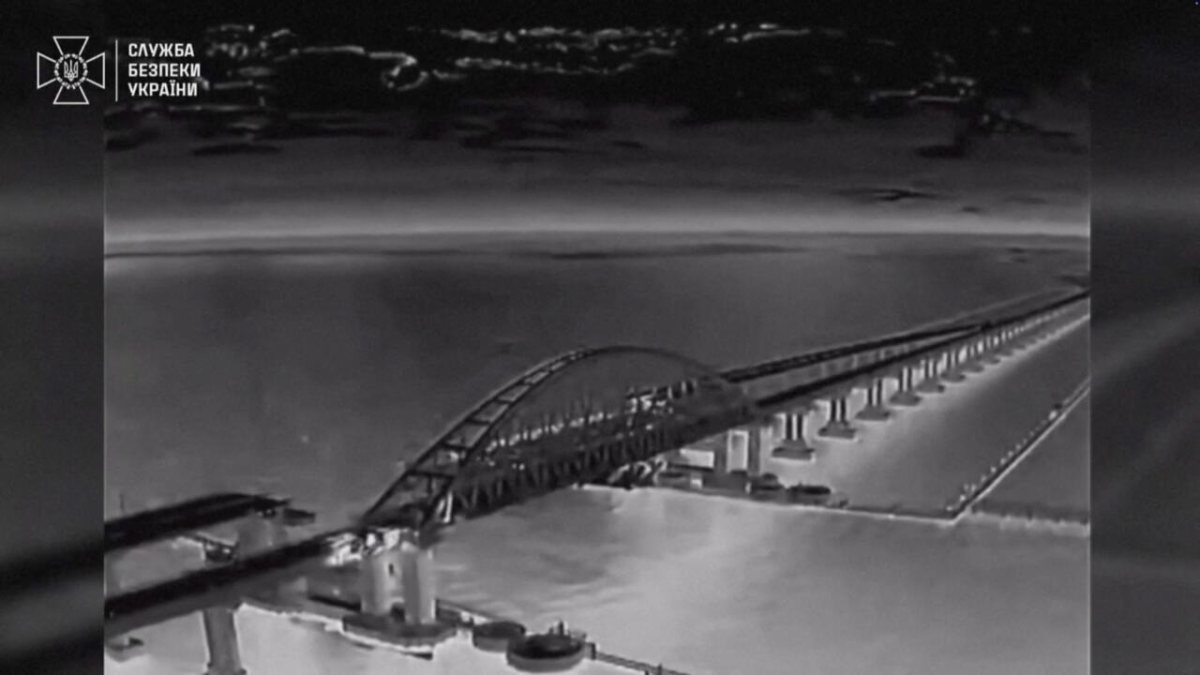
A Ukrainian barrage of drones and cruise missiles has brought down part of the road section of the Kerch Strait Bridge, the crossing that links the annexed Crimean Peninsula to mainland Russia, according to France 24.
The bridge has long served Moscow as a route for moving troops and military supplies into Crimea and towards the southern front in Ukraine.
The attack came in two waves on Sunday and Monday nights. The first left one of the bridge's twin arches leaning to one side. The second sent the arch, along with the highway section beneath it, falling into the sea.
Rail link still running
The railway that runs alongside the road has resumed operating, France 24 reported. Footage recorded on phones by train passengers shows a wide gap where the roadway used to be.
Video from Ukrainian surveillance drones showed concrete and steel debris lying in the water below. The strait is a key shipping lane connecting the Russian-held Sea of Azov with the Black Sea.
This is the fourth attack on the bridge since Russia began its full-scale invasion of Ukraine in 2022.
A seven-stage operation
Ukrainian President Volodymyr Zelensky said on Tuesday that the strikes were the last step in a seven-stage military operation. He said earlier phases had steadily degraded Russian radar, air defences and electronic jamming equipment, leaving the bridge open to a final assault launched from southern Ukraine.
In a social media post, Zelensky described the attack as a message Moscow should not be allowed to forget.
The timing also appeared deliberate. The arch came down on the eve of a three-way meeting in Shenzhen on Wednesday between Russian President Vladimir Putin, US President Donald Trump and Chinese President Xi Jinping.
A symbol for both sides
The bridge was built after Russia annexed Crimea in 2014 and carries heavy symbolic weight. For Kyiv, it represents Putin's seizure of Ukrainian land. For Moscow, it marks Crimea's return to Russia, decades after Soviet leader Nikita Khrushchev transferred the peninsula from the Russian to the Ukrainian Soviet republic.
Less flexibility for Moscow
Natia Seskuria, who heads the Russia, Eurasia and Black Sea Security Programme at the UK-based Royal United Services Institute, told France 24 that the bridge gave Russia a direct road and rail connection to Crimea, particularly in the early stages of the war.
However, in the first months of the 2022 invasion, Russian forces captured Ukrainian territory along the Sea of Azov, creating a land corridor between Crimea and Russia's Rostov region. Seskuria said this corridor had reduced Moscow's reliance on the bridge without making it redundant.
That land route has itself come under growing pressure. Over the past year, Ukraine has intensified what France 24 described as mid-range drone strikes on rail lines, ports, energy facilities, bridges and other crossings behind the front.
Seskuria said the latest damage would complicate Russian logistics but would not cut off Crimea or sever supplies to the southern front. The main consequence, she said, was a loss of flexibility, as Russia would have less room to reroute traffic when delays or disruptions occur.
Civilians likely to feel the impact
The bridge also remains an important everyday link for Russian troops stationed in Crimea and for the peninsula's civilian population. Over the summer, Crimean authorities imposed sweeping fuel restrictions after Ukrainian strikes on oil depots, fuel tankers and transport facilities.
Seskuria said residents could expect transport disruptions, slower deliveries of goods and possibly higher transport costs, depending on how quickly normal traffic returns.
The Kremlin moved to play down the damage. Spokesperson Dmitry Peskov said: "There is no doubt that the bridge will be restored – and will be even better than it was before."
This story was prepared by the Hamasta Newsdesk with AI assistance, based on reporting by France 24. Read the original report. Photo: France 24.


Take your event live to thousands.
Multi-camera live streams, panel discussions and digital broadcasts with professional crews.




More in International
See all
Houthis near Aden may choose siege over assault to force talks, analysts say
Muslims projected to outnumber Christians worldwide by 2035, Pew study finds
Gazans flee as Israeli troops push beyond Yellow Line in central Gaza
Russian strikes on Ukraine kill at least five, most of them in Odesa
US Navy chief says Hormuz insurance now $64m per crossing as shipping stays depressed

Global Community Remarks
0