
Xi hails turnaround in China-Australia ties as Albanese vows constructive engagement
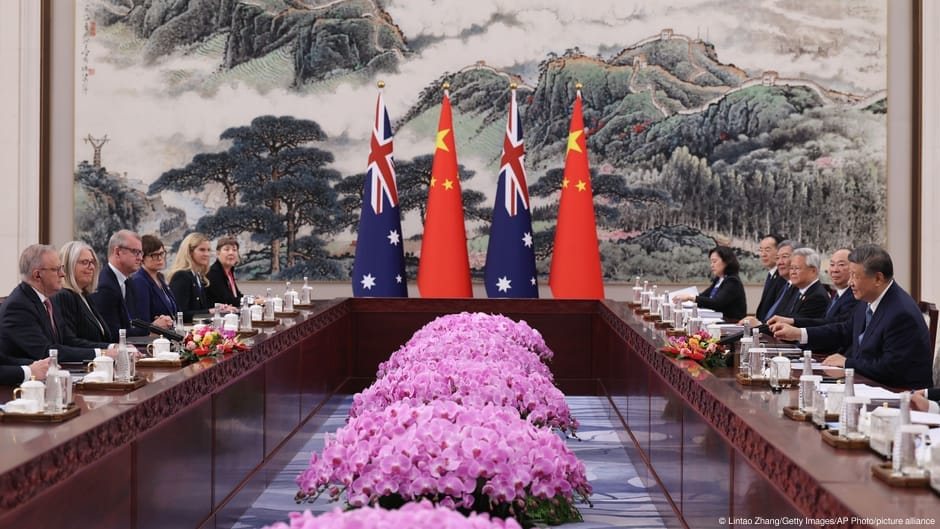
Chinese President Xi Jinping has declared that relations between China and Australia have undergone a complete recovery, following talks with Australian Prime Minister Anthony Albanese on Friday, according to DW News.
The two leaders met on the sidelines of the Asia-Pacific Economic Cooperation (APEC) summit in the southern Chinese city of Shenzhen. After the meeting, Albanese said Australia was engaging with Beijing in a constructive manner.
Xi reminded his guest that the pair had now met four times since Albanese took office in 2022, and credited their joint efforts with bringing about a comprehensive turnaround in ties between the two countries.
Push for wider cooperation
According to China's state news agency Xinhua, Xi called for the two nations to deepen cooperation in several sectors, including agriculture, energy, the green economy and artificial intelligence.
Albanese, speaking to reporters on Friday, stressed the importance of continued dialogue with Beijing while acknowledging that disagreements remain.
"It is important that Australia continue to engage in a constructive way with China, manage our differences, but not be defined by them," Albanese said.
He added that developments in China have a direct bearing on Australia.
From sanctions to thaw
The warmer tone marks a sharp change from just a few years ago, when relations between the two countries sank to their lowest point. Under Australia's previous centre-right coalition government, Canberra called for an independent investigation into the origins of the coronavirus.
Beijing responded angrily, imposing import restrictions worth $13 billion (about €12.2 billion) on a range of Australian goods, including timber, coal, barley, lobsters and wine.
Since Albanese's centre-left Labor Party took power, China has removed most of those trade barriers on Australian exports.
Lingering friction
Despite the improvement, tensions have flared from time to time. Points of friction have included a Chinese missile test in the South Pacific and Australia's decision to tighten foreign investment screening in the critical minerals sector.
Iron ore has also emerged as a fresh source of strain. On Monday, Australia, the world's largest producer of the commodity, accused China of "manipulation" of the iron ore trade. The complaint centres on Beijing's creation of a central purchasing body that buys ore on behalf of Chinese steelmakers.
A single buyer of this kind enjoys greater bargaining power when negotiating prices with suppliers, a concern for Australian producers who rely heavily on the Chinese market.
Business talks in Beijing
Albanese was expected to travel to Beijing later on Friday to meet Chinese Premier Li Qiang, DW News reported.
The two are due to attend a business roundtable bringing together senior executives from Australian mining giants Rio Tinto and BHP alongside leaders of Chinese companies.
The meeting is likely to put the iron ore dispute and wider trade relations at the centre of discussions, as both governments try to build on the recent recovery in ties while managing the issues that continue to divide them.
This story was prepared by the Hamasta Newsdesk with AI assistance, based on reporting by DW News. Read the original report. Photo: DW News.


Grow an audience that listens.
Social media management, digital campaigns and online storytelling that converts.



More in International
See all
Pakistani minister visits New Delhi for SCO forum, first such trip since 2023

Young Europeans plan coordinated cost-of-living protests across more than 25 countries
US maritime agency memo flagged Iran blockade's role in soaring Gulf shipping costs
Tinubu asks Nigerian lawmakers to scrap jail terms for attempted suicide
Contaminated petrol batters Yemeni drivers as prices and repair bills climb

Global Community Remarks
0